
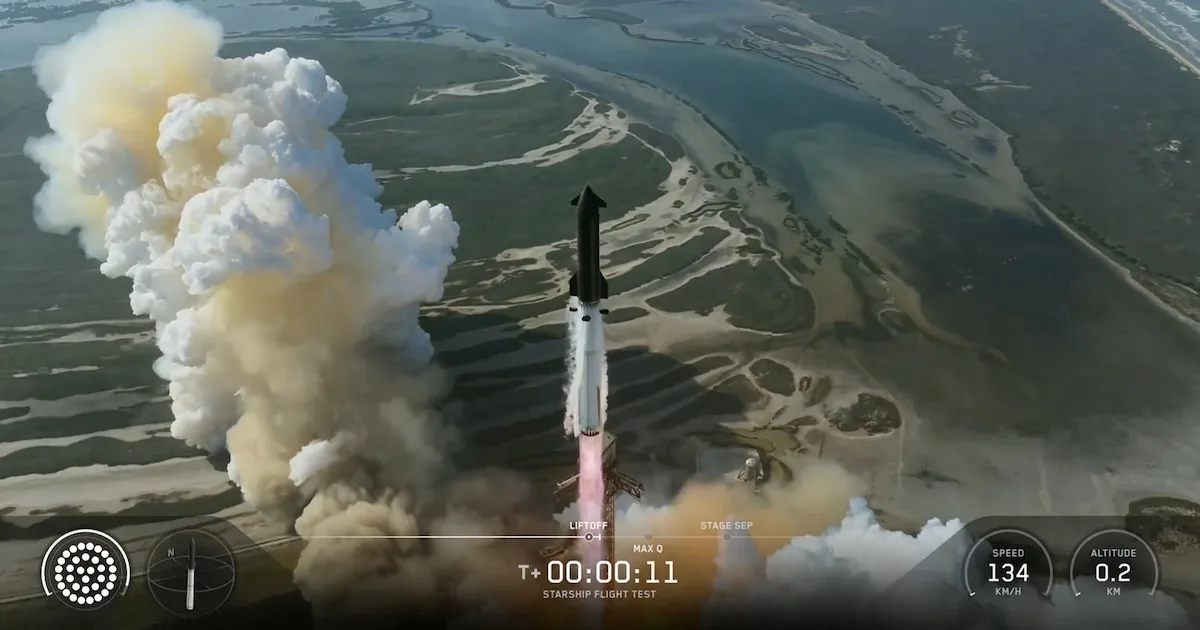


In the heat of South Texas, SpaceX's Starship V3 rocket finally took to the sky after a failed attempt that made many in Boca Chica nervous.
The successful launch not only eased tensions but also reignited ambitions to explore beyond Earth. The atmosphere at the launch base was electric, with engineers and technicians gathered in a mix of anticipation and anxiety.
A launch that defied destiny
The previous day, the atmosphere at Starbase was tense. Engineers, technicians and curious people gathered around screens and platforms, waiting for the takeoff that did not come.
An unexpected failure in the hydraulic pin of the tower arm forced the launch to be canceled at the last second, leaving many with bated breath and Elon Musk promising a new attempt.
Twenty-four hours later, at 5:30 p.m. local time, the roar of the Raptor engines broke the silence. Starship V3 pulled away from Earth with a force that seemed to defy gravity itself. Applause and cheers echoed among those present, who captured the moment on their mobile devices.
A mission full of expectations
The flight of Starship V3 was not just a visual spectacle. It represented a crucial step in SpaceX's goal of landing humans on the Moon and, eventually, Mars.
To achieve this, the rocket had to demonstrate not only its power, but also its reusability, a technical challenge that has kept engineers guessing for years.
The heat shield, a structure of 40,000 tiles, underwent extensive testing. Two satellites equipped with cameras monitored its performance from space. In mission control, nerves were palpable as data came in in real time.
The mission also included the deployment of 22 Starlink minisatellite simulators, demonstrating the rocket's ability to deliver significant payloads to space. This deployment is essential to the expansion of SpaceX's global internet network.
The launch's success also represents an important step for NASA's Artemis program, which aims to take astronauts back to the Moon and beyond. The symbiotic relationship between SpaceX and NASA is evident, as both share the vision of advancing space exploration.
Overcoming obstacles in the space race
The successful splashdown in the Indian Ocean, after completing a partial orbit, was the culmination of months of preparation and technological adjustments. The return of the Super Heavy booster to the Gulf of Mexico, just seven minutes after liftoff, was equally crucial.
Each successful maneuver brought SpaceX closer to its goal. In the control room, the applause was immediate when the successful landing was confirmed. The engineers' eyes shone with a mix of pride and relief.
The progress is closely followed by NASA, which has Starship for future lunar missions under the Artemis program. The success of SpaceX is also a success for NASA, which sees these tests as validation of its trust in private companies.
The tests are also a reminder of the dangers inherent in space exploration. Every launch is a delicate dance with physics and engineering, and any mistake could have devastating consequences.
The human impact and future of exploration
With each launch, SpaceX not only seeks to beat its own records. Each success is a clear message: space exploration is within reach, and the Starship is its vehicle.
The road is undoubtedly fraught with challenges, but the milestone reached in Texas is a testament to perseverance. In the small town of Boca Chica, local residents feel like they are part of a historic chapter. Nearby bars and restaurants were filled with discussions about the future of humanity in space.
The ambition to establish a human presence on Mars feels more tangible than ever, with Starship V3 paving the way to a future that, until recently, seemed to belong only to science fiction. The implications of this achievement go beyond the limits of the Earth's atmosphere.
For future generations, the possibility of living on another planet will not be a distant dream, but a real option. In classrooms, students debate the impact of these advances, dreaming of being part of the next wave of space explorers.
The success of Starship V3 represents renewed hope for humanity. In a world facing significant terrestrial challenges, looking to the stars offers a fresh perspective and a reminder of what we can achieve when we combine innovation, determination and collaboration.
Additionally, these types of technological advances have the potential to boost other industries, from communication to scientific research. The infrastructure created for space exploration can have applications in daily life, improving transportation and communication technology on Earth.
This successful launch is more than a technical achievement; It is a symbol of human ingenuity and our ability to dream big and achieve the impossible. The global community watches in awe and hope, aware that these advances are the first step towards a future where space is not just a destination, but a new home.
Subscribe to Uruguay Al Día
Receive the most important news directly in your email. Clear, independent and updated information every day.
Follow us on WhatsApp
Join our official channel and receive alerts, news and exclusive content from Uruguay Al Día.
🔔 Join the WhatsApp channel