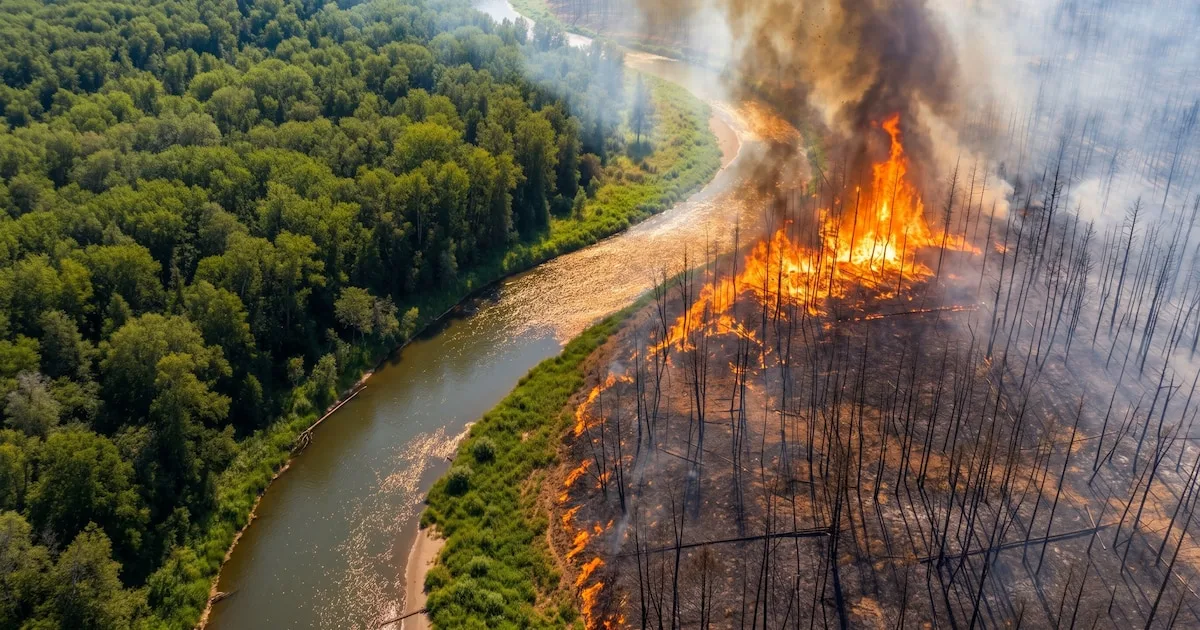

The smoke clears and the flames die down, but the real challenge is just beginning. In regions affected by forest fires, drinking water becomes a silent victim. Scientists at the University of British Columbia reveal a disturbing picture: the damage can persist for five years.
The consequences of the fires go beyond the immediate devastation. In many communities, the water coming out of the tap may be loaded with contaminants. This phenomenon, ignored by many, threatens to redefine the notion of environmental catastrophe.
A contaminating legacy in drinking water
The research, published in the journal Science of the Total Environment, reveals the harsh reality. After fires, the levels of turbidity and suspended solids in the water can shoot up to 39,600%. The particles, invisible to the human eye, transform water into a silent trap.
The effects are evident in hydrographic basins in various regions. At rural fairs, villagers murmur about the metallic taste of water, while children play, oblivious to the danger. Researchers warn: the problem does not evaporate with smoke.
Heavy metals and the danger of PAHs
The study highlights an alarming increase in heavy metals and PAHs, compounds with carcinogenic potential. Environmental regulations are relegated to simple recommendations, incapable of containing the ongoing disaster.
In a small town, an old man watches the murky river from his porch. Remember times when the water was crystal clear. Now, every sip brings with it a dose of uncertainty. The conversations in the square revolve around the insecurity of the most vital resource.
This old man, with his worn hat and his gaze fixed on the river, has become a symbol of resistance. Stories of their sick grandchildren circulate in the neighborhood, generating fear and solidarity in equal measure.
Challenges for treatment systems
Water treatment plants, designed for a world without fires, are struggling to adapt. In cities, engineers review their manuals, looking for solutions to a problem that is no longer theoretical.
At an emergency meeting, local officials discuss the need to invest in advanced technology. But the municipality's coffers are empty, and bureaucracy slows down any effective response.
The director of a treatment plant looks at the daily reports with concern. He knows that every day that passes without improvement is a day that his community is in danger. The decisions you make could mean the difference between well-being and illness.
Plant workers, their mud-stained uniforms, share stories of endless shifts. They know they are on the first line of defense, and the pressure is palpable.
The human impact and the way forward
At home, families face a new reality. Bottled water becomes a luxury, while rumors about water-related illnesses fill WhatsApp groups.
A mother, with her baby in her arms, shares her anguish in a home video that quickly goes viral. The worry is palpable, and her voice cracks as she talks about her fear for her son's future.
The study not only offers a diagnosis, but also a call to action. Communities must prepare for a future in which wildfires not only destroy forests, but also poison their water sources.
In this new scenario, adaptation is crucial. Only by changing our relationship with the environment and adopting preventive measures can we mitigate the impact of these disasters on water quality.
Local authorities begin to organize information workshops. Neighbors, notebooks in hand, write down tips on how to filter water at home and what signs of contamination to look for.
The question that remains is: are we prepared to face this new reality? Around every corner, the debate continues, and the river, once the source of life for the community, is now the epicenter of a crisis no one saw coming.
The challenge is not only technical, but also social. Communities are forced to redefine their priorities, mobilize to demand effective responses and unite in the search for sustainable solutions.
Community leaders, previously focused on infrastructure projects, are now overwhelmed by health emergency meetings. The agenda has changed, and with it, the perception of environmental risk.
Meanwhile, in schools, teachers are adapting their lessons to teach children about the importance of clean water. Classrooms become spaces for awareness, where the topic of water is as crucial as mathematics or history.
The future of these communities depends on their ability to adapt and confront the problem with creative solutions. Resilience is being tested, and society's response will be critical to ensuring a secure water supply for generations to come.
Subscribe to Uruguay Al Día
Receive the most important news directly in your email. Clear, independent and updated information every day.
Follow us on WhatsApp
Join our official channel and receive alerts, news and exclusive content from Uruguay Al Día.
🔔 Join the WhatsApp channel