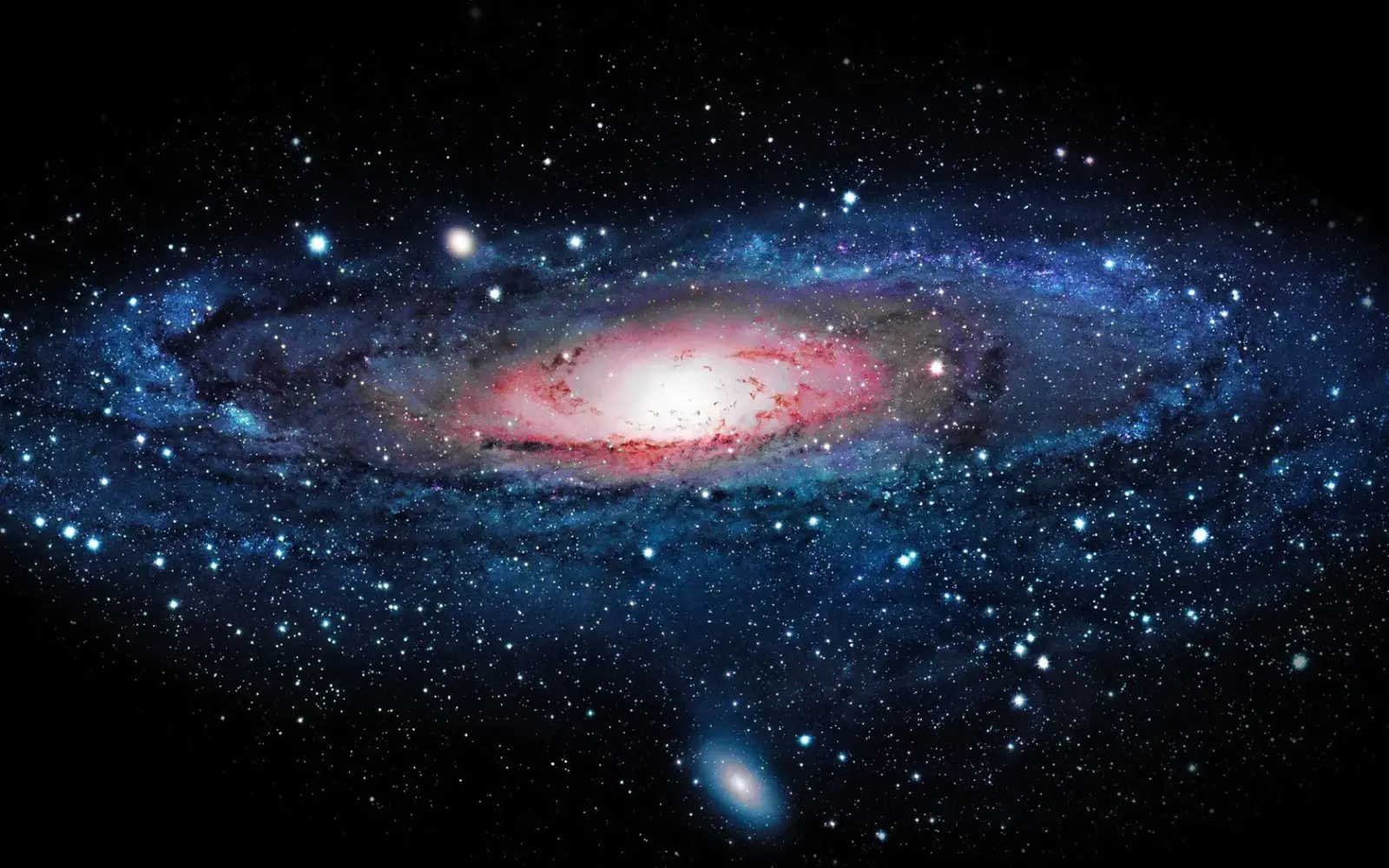


The cosmos has its own ways of whispering the secrets of its childhood, and this week, astronomers managed to tune into one of the sharpest and most distant signals ever captured. About 8 billion light years away, at the edge of what we can observe, a hydroxyl megamaser was recorded. Translated into ordinary language: a beam of natural energy so intense that it acts like a cosmic laser, illuminating a stage of the universe where everything was much more chaotic, violent and, above all, young.
For the team of researchers led by Thato Manamela and Roger Deane, from the University of Pretoria, the discovery is not a coincidence. They used the MeerKAT radio telescope in South Africa, a machine capable of filtering out the background noise of space with surgical precision. “It was like trying to hear a whisper in the middle of a storm,” say those who worked on big data processing at the IDIA institute.
The crash that turned on the light
What exactly did we see? Imagine two giant galaxies colliding. This fusion process is neither silent nor orderly; It is a gravitational cataclysm where gas is compressed, molecular clouds collapse and stars are born at an unbridled rate. In the midst of this chaos, the hydroxyl megamaser emerges. It is, in essence, a microwave beacon that tells us that, 8 billion years ago, that part of the cosmos was in full boiling water.
The signal arrived at Earth at a significant “redshift,” a signature that confirms it has traveled through the expansion of the very fabric of the universe. What makes this case special is not just the distance, but the natural amplifier they had in their favor: a gravitational lens. A massive galaxy, located between us and the distant object, acted like a giant magnifying glass, deflecting and concentrating light toward our telescopes. Without that cosmic “help,” we would have needed hundreds of hours of observation; here, five were enough.
“Drinking from a fire hose”
Processing the information that comes from a radio telescope of this magnitude is a technical challenge that borders on the absurd. Researchers describe the flow of data as “drinking from a fire hose”: gigabytes of radio noise that must be cleaned, calibrated and analyzed by supercomputers to extract, from the chaos, a coherent chemical signature.
Those data revealed not only hydroxyl, but also neutral hydrogen, giving us a detailed map of the cold gas powering that distant galaxy. It is, in many ways, seeing the basic structure of stellar creation at a stage when the universe was not yet in the mature form that we see today in our own Milky Way Galaxy.
Why do we care about this sign?
Beyond the fascination with the distant, this discovery is a tool. Megamasers function as markers, traffic signs on the cosmic highway that tell us where galaxies are actively merging. Understanding these processes is key to solving how supermassive black holes grew and how galaxies came to accumulate the mass they exhibit today.
We are only in the first stages of this new astronomical era. With the future deployment of the Square Kilometer Array (SKA), the ability to identify these objects will grow exponentially. Soon, instead of an isolated find, we will have a complete catalog of these cosmic beacons. The data “firehose” is just beginning to open, and what we see on the other side is a history of the universe that we are only beginning to understand.
Subscribe to Uruguay Al Día
Receive the most important news directly in your email. Clear, independent and updated information every day.
Follow us on WhatsApp
Join our official channel and receive alerts, news and exclusive content from Uruguay Al Día.
🔔 Join the WhatsApp channel