Montevideo under fire: when a worker's life is worth less than a motorcycle and the State looks the other way
The insecurity in Uruguay has ceased to be a statistic in management reports and has become the cry of a mother who, just a few hours ago, received the news that her son will not return home after the delivery.
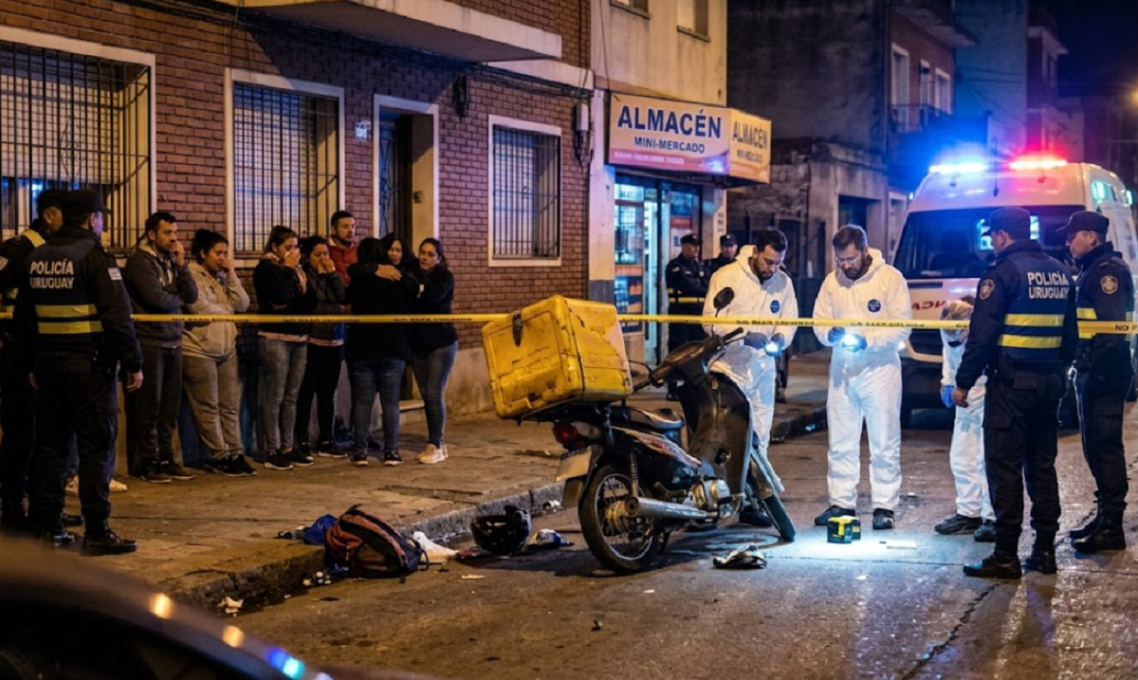
Today, the Uruguayan capital woke up - if it sleeps amidst the echo of gunshots - with the blood of a young delivery man spilled on the cold asphalt. The mobile: a used motorcycle. The price: a human life. This latest crime is not an isolated incident, it is the final symptom of a metastasis of violence that the current left-wing government seems incapable, or worse yet, unwilling to eradicate. While the authorities get lost in euphemisms and desk "strategic plans", the ordinary citizen has gone from being sovereign to being a prey in his or her own territory.
The surrender of the State in the face of daily barbarism
What happened moments ago in the streets of Montevideo is the confirmation of a suspicion that is now certain in the neighborhoods: the Uruguayan State has given up. The death of the delivery worker, executed in cold blood by criminals who despise the existence of others, is proof that the social contract in Uruguay is broken. It's no longer about "wind chill," it's about a body count that doesn't stop.
Since the administration of Yamandu Orsi assumed the responsibility of caring for Uruguayans, the discourse has focused on social causes, theoretical rehabilitation and "multilateral dialogue." However, the criminal does not dialogue; the criminal shoots. The insecurity in Uruguay has mutated towards a ferocity never seen before, where the value of life has fallen to discardable levels. The current management, anchored in a romantic and failed vision of prevention, has left the Police's hands tied and the neighborhoods at the mercy of warlords who operate with total impunity.
The failure of the "outstretched hand" against the closed fist of crime
He National Plan of Public Safety, recently introduced with great fanfare, has been met with skepticism—and rightly so—by experts and citizens. Ignacio Munyo, from Ceres, warned clearly: it is a plan that lacks resources and political decision. But beyond the numbers, what is missing is courage. The government seems to be more afraid of criticism from groups of human rights than the hitmen who today dominate peripheral areas and shopping centers alike.
How do you explain to the family of the murdered worker today that the government is "studying the variables of crime"? There is no study that returns a father, a son or a brother. The narrative of the Uruguayan left has tried to divert attention towards the "inheritance received" or "global complexity", but the reality is much simpler and more painful: under its watch, homicides in Montevideo have become a macabre routine. Every morning, the headlines announce a new discovery of remains, a reckoning in the middle of a public street or, like today, the sacrifice of an essential worker on the altar of government apathy.
A system that punishes the honest and rewards the violent
Uruguay has become a country of bars, cameras and alarms, where the only one who circulates freely is the criminal. Prisons, far from being rehabilitation centers, are universities of crime that spit out thirty people every day without any type of control, according to technical organizations. The flow of unrehabilitated criminals returning to the streets is a ticking time bomb that the Home Office refuses to deactivate.
The current approach of Uruguayan justice seems to be designed to protect the criminal process of the perpetrator before the integrity of the victim. While the government resists applying control measures Effective territorial control, the residents of Casavalle, La Teja or El Cerro live in a self-imposed state of siege. The insecurity in Uruguay It does not distinguish between ideologies, but the response to combat it should be clear: either you are with the law, or you are with chaos. The Orsi government has, until now, chosen a lukewarm middle ground that has only served to embolden organized gangs.
The echo of Rosario on the coasts of Montevideo
The warning from international figures such as Patricia Bullrich in recent forums should not fall on deaf ears. Organized crime is not negotiated, it is confronted. Uruguay is traveling the dangerous path of the "naturalization" of homicide. We are no longer shocked by the 10% homicide rate; We have become accustomed to broken glass and closed wakes.
The murder of delivery today is a cry for help from a society that feels helpless. It is not a lack of cameras, it is a lack of support for public forces. It is not a lack of diagnoses, it is a lack of maximum security prisons and a judicial reform that stops seeing the criminal as a victim of the system. If the current government is unable to guarantee the most basic right of all – the right to life – then its legitimacy to govern is in question.
Conclusion: The time for words has run out
The asphalt of Montevideo still retains the heat of today's tragedy. The insecurity in Uruguay has gone from a concern to a persistent national tragedy. Yamandú Orsi's government has two paths before it: either it assumes the political cost of a legitimate and professional repression of crime, or it continues to allow the streets to be governed by fear.
For the delivery man who lost his life today due to a motorcycle, the State was late. For his colleagues who will go out to work today with their hearts in their mouths, the State is an absent shadow. History will judge this administration not by its speeches of social justice, but by how many honest Uruguayans it let die in the name of an ideology that fears authority. Uruguay demands security. Uruguay demands order. Uruguay demands, above all things, that stopping dying for nothing is the absolute priority of Palacio Estévez.
Leave your comment
To comment you must be registered and logged in.
Comments (0)
There are no comments yet.