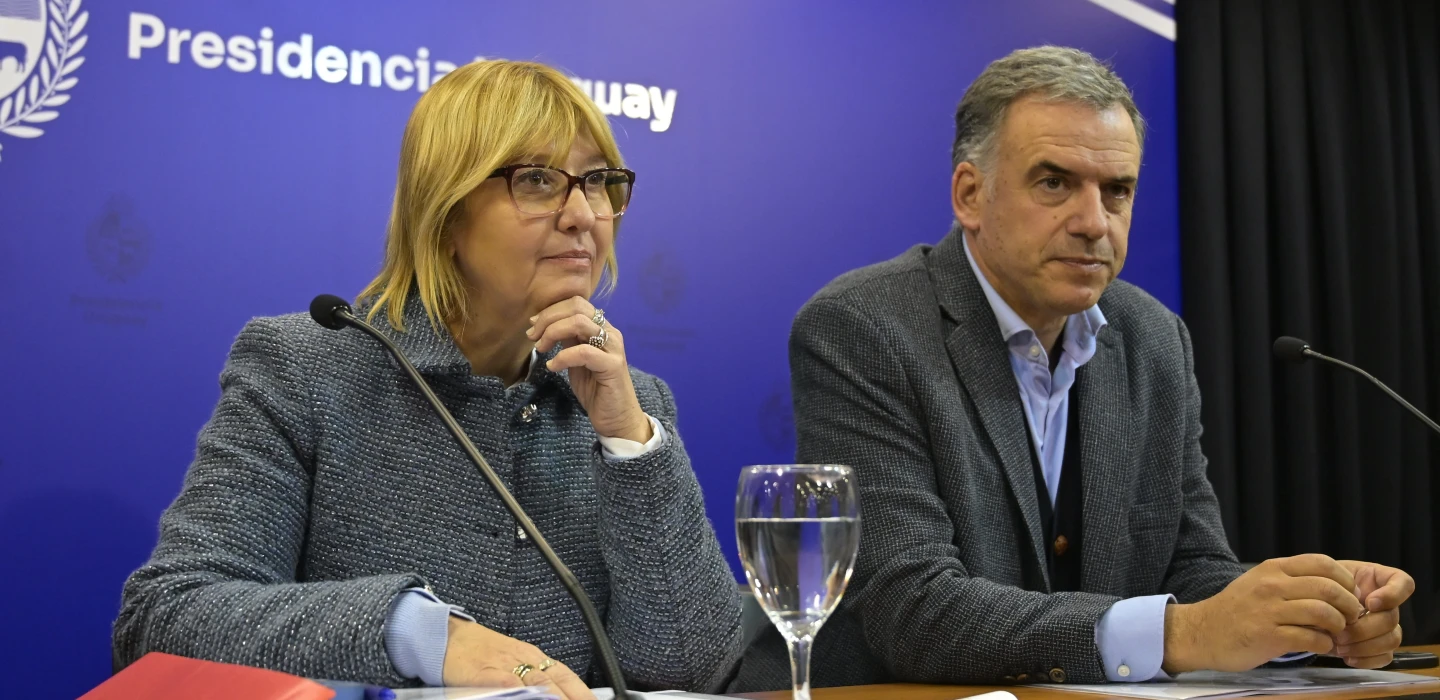


The purge in Public Health It has ceased to be a hallway rumor and has become an institutional earthquake. What began as a “renewal of profiles” has mutated into an emptying of the technical leadership of the Ministry of Public Health (MSP). This Thursday, Minister Cristina Lustemberg is preparing to announce a dozen hierarchical changes, in a desperate attempt to regain control of a portfolio that seems to navigate between the insubordination of its technicians and an ideological agenda that collides with the reality of the health market.
Orsi's support: a double-edged card
President Yamandú Orsi has opted for diplomatic caution, but with an underlying message that did not go unnoticed in the Executive Tower. Although he conveyed his support to Lustemberg to carry out the necessary removals, the president was emphatic: each Secretary of State must “take responsibility” for the consequences of their decisions. In political terms, Orsi has let go of improvisation; The support is administrative, but the political responsibility in the event of a possible collapse of health management will be exclusively that of the minister.
This crisis is triggered after the resounding departure of Fernanda Nozar, who led the General Directorate of Health (Digesa). Nozar, a professional of very high academic prestige, left her position in the midst of “current tensions” that hide a deeper crack: the resistance of technicians to a leadership that prioritizes political loyalty over scientific rigor. She was joined by Gilberto Ríos, her number two, and Steven Tapia Villacis, a key player in Immunizations who preferred the refuge of Udelar rather than continuing under the command of a worn-out management.
The iron circle and the shadow of ASSE
To cover the potholes of this purge in Public Health, Lustemberg has confined himself to his “small table”, a group where personal confidence outweighs technical suitability in public health. In this circle, Álvaro Danza, president of ASSE and Orsi's personal doctor, stands out, who today faces his own media ordeal. Danza's move to criminally denounce the previous management of Leonardo Cipriani has been interpreted by many as a smokescreen to hide current irregularities, such as paying bonuses for “permanent dedication” while maintaining other jobs.
The departure of Daniel Olesker from the vice presidency of ASSE to the Ministry of Industry finishes confirming the picture: the political cadres who do not agree with Lustemberg's verticalism or who maintain a less radicalized vision of the healthcare system They are being ejected or displaced to other areas of the State.
Ideology vs. Reality: the war over wages and insurance
The background of this crisis is not just names, but a philosophical vision that has put the Uruguayan Medical Union (SMU) on a war footing. Lustemberg has publicly flirted with the idea of “capping” medical salaries and restricting the private insurance market, calling health a right that “the market cannot regulate.” These statements earned him a head-on collision with José Minarrieta, president of the SMU, who reminded him that the guild will strictly defend the salaries of its members.
As if that were not enough, the deputy Federico Preve has launched his own agenda, promoting a bill which triples the contributions of private insurance to Fonasa. This initiative has generated an internal fracture in the Wide Front. While the minister tries to maintain an institutional roadmap, her own political sector and allies seem to be playing their “own game” that suffocates the mutual system and generates panic in private insurance and in the interior institutions grouped in Fepremi.
Don't gauchos step on the poncho?
Despite the cross-complaints and the creation of parliamentary investigative commissions requested by the National Party to investigate efforts since 2015, an unwritten maxim always hovered in Uruguayan politics. However, on this occasion, the ferocity of the attacks seems to have broken the codes of coexistence. “Among gauchos they do not step on the poncho”It is often said in the deep interior, but in the offices of the MSP the poncho is more than trampled. Danza's decision to judicialize the previous administration has broken the gentlemen's agreement and has forced the opposition to counterattack with an investigation that promises to bring to light everything from hiring "toasts for 700 people" to suspicious transfer tenders awarded to taxi drivers.
Unrest also boils in the lower echelons of the Ministry. The figure of Rodrigo Márquez, general director of the Secretariat and Lustemberg's most trusted man, is seen as an authoritarian obstacle that tries to exert a “bridge” that looks more like a wall. The area directors complain of a parallel hierarchy where Márquez commands his peers, even intervening in details as pedestrian as the restructuring of the building, which almost ended in a riot by Digesa workers.
Conclusion: A Ministry in a state of siege
The purge in Public Health that is taking place today is the symptom of an organization that has lost the technical compass in favor of an ideological trench. Lustemberg keeps the “loyal” ones, but loses the “capable” ones. With President Orsi looking askance and an investigative commission in the making, the Ministry of Public Health enters a phase of instability where the only person harmed, at the end of the day, will be the user of the National Integrated Health System. The health of Uruguayans should not be the spoils of war for a partisan internal party, but the facts show that, today, in the MSP, politics has won the game over medicine.
Subscribe to Uruguay Al Día
Receive the most important news directly in your email. Clear, independent and updated information every day.
Follow us on WhatsApp
Join our official channel and receive alerts, news and exclusive content from Uruguay Al Día.
🔔 Join the WhatsApp channel