
Trump cancels his delegation's trip to Islamabad and cedes the initiative to Iran
The Iranian Armed Forces warn of a response with "more serious damage" if the US and Israel resume the offensive
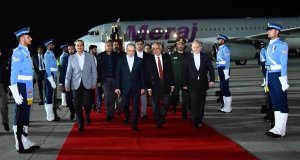
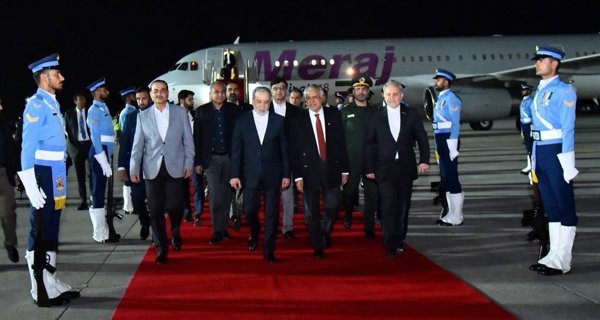
The Foreign Minister of Iran, Abbas Araqchi, handed over this Saturday to the head of the Pakistan Army, General Asim Munir, a list of Tehran's "responses" to the United States proposals that it had previously received from the Pakistani mediation to consolidate the ceasefire in force and still without prospects of a meeting with the North American delegation that will also meet with the Pakistani authorities in the country's capital, Islamabad.
Araqchi and his delegation also met in the Pakistani capital with the country's prime minister, Shahbaz Sharif. Araqchi and Sharif gave each other a effusive hug, according to a video published by the Iranian diplomat himself on social networks.
The head of Iranian diplomacy has expressed his gratitude for the "valuable efforts" of the Pakistani Government, "in particular of General Asim Munir" to achieve a ceasefire "and the end of the war," Araqchi highlighted.
Munir, for his part, has valued Iran's confidence in Pakistan's efforts and has expressed his country's willingness to continue with mediation "until a result is achieved," Araqchi has also published.
The Iranian authorities have already announced that they have no intention of meeting this Saturday with the American representatives (President Donald Trump's son-in-law, Jared Kushner, and Middle East advisor Steve Witkoff), and that Araqchi's visit to Pakistan is the first of the regional tour that will take the diplomat in the coming days to Oman (mediator in the frustrated diplomatic talks on the Iranian nuclear program) and Russia, Iran's great ally.
Iranian state radio and television has limited itself to specifying that the note delivered by Araqchi "is exhaustive and addresses all of Tehran's concerns" without giving more details.
The uncertainty does not hide the high caliber of the meeting held this Saturday by Araqchi with the senior staff of the Pakistani security establishment, the most important in the country. The Army chief has been accompanied by Pakistan's national security advisor, Asim Malik, and the Interior Minister, Mohsin Naqvi.
Araqchi has been accompanied by his deputy, Iran's Deputy Foreign Minister, Kazem Gharibabadi; the Iranian ambassador to Pakistan, Reza Amiri-Moghaddam and the spokesman for the Iranian Ministry of Foreign Affairs, Esmaeil Baqaei.
The "note" delivered by Baqaei suggests that Iran has decided to opt for a model of indirect talks after the failure of the meeting on April 11 and 12, which concluded after more than 20 hours without an agreement. Since then, exchanges have continued indirectly through Pakistan, with both sides adjusting their positions while avoiding a formal breakup.
After these meetings, Araqchi left for Oman. "A very fruitful visit to Pakistan, whose good offices and fraternal efforts to bring peace back to our region are highly valued," he posted on social networks.
«I have shared Iran's position for a feasible framework that permanently ends the war against Iran. It remains to be seen if the United States is serious about diplomacy," he added.
Already in Muscat, Araqchi has met with senior Omani officials to discuss bilateral relations and the regional situation, the Ministry of Foreign Affairs reported.
Meanwhile, the president of the United States, Donald Trump, has announced the cancellation of the trip of the American delegation to Islamabad. «I just canceled the trip of my representatives to Islamabad, Pakistan, where they were going to meet with the Iranians. "Too much time wasted traveling and too much work," Trump said in a message posted on social media.
Trump also believes that there is a "tremendous internal struggle" and "confusion" within the Iranian leadership. «No one knows who is in charge. Not even them," he indicated.
«Besides, we hold all the cards. They don't have any! If they want to talk, all they have to do is call," he argued.
In subsequent statements before boarding 'Air Force One', Trump commented on the latest Iranian proposal. «They have given us a document that should have been better. It is interesting that when I rejected it, ten minutes later we received another document that was much better," he said.
The US president has stressed that Tehran "has offered a lot, but not enough" and regarding the contacts, he explained that "we are going to do it by phone." "They can call us whenever they want," he said.
Meanwhile, the spokesman for the Iranian Armed Forces, Ebrahim Zolfaqari, warned the United States again this Saturday that if it maintains the blockade with "banditry and piracy", "there will be a response from the powerful Iranian Armed Forces."
Zolfaqari has stressed that Iran "manages and controls the strategic Strait of Hormuz" and could "inflict more serious damage on US-Zionist enemies if they invade again."
"The Armed Forces of the Islamic Republic of Iran are more powerful and more prepared than ever to defend sovereignty, territory and national interests," he warned.
The ceasefire between the parties, originally negotiated between April 7 and 8, has been extended without a defined deadline, creating space for diplomacy but also prolonging uncertainty.
Leave your comment
To comment you must be registered and logged in.
Comments (0)
There are no comments yet.