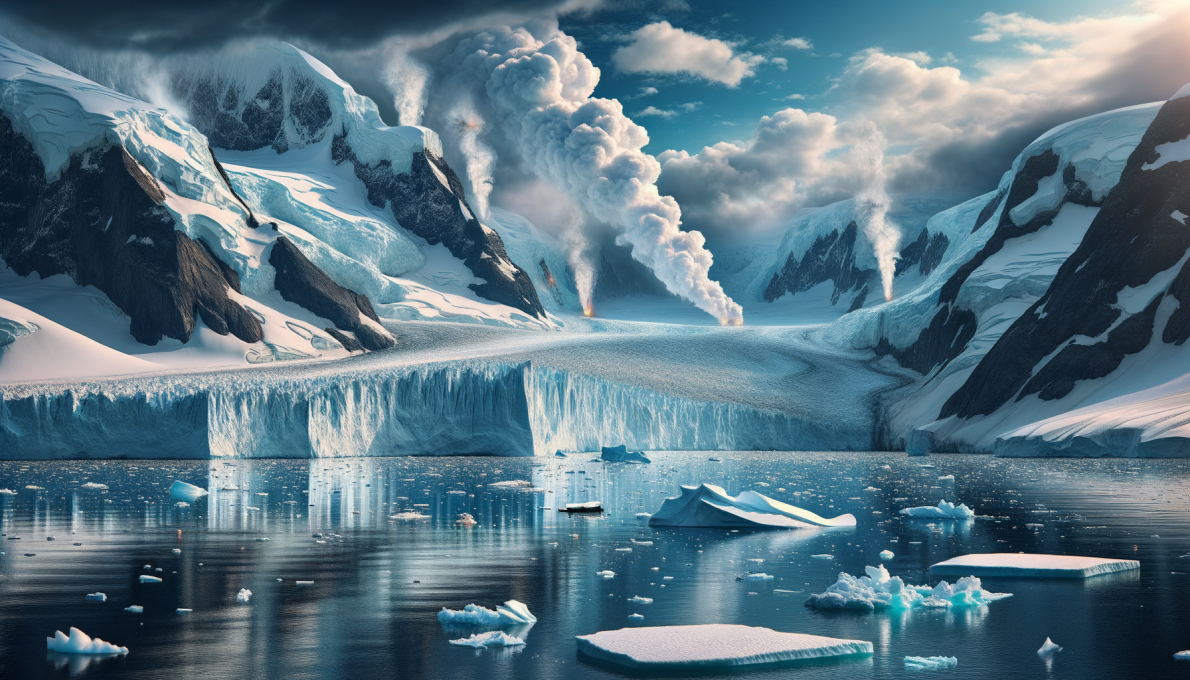
Ice dynamics in Antarctica have begun to resemble those in Greenland, with an increase in the rate of melting, the collapse of ice shelves and a growing loss of ice heading towards the sea. This alarming scenario has been documented in a study titled 'The Greenlandification of Antarctica', published in the journal Nature Geoscience, in which three researchers from the Danish Meteorological Institute (DMI) are listed as main authors.
Historically, Antarctica has been believed to be more stable than the Arctic. However, conditions have changed dramatically in recent years. Sea ice is disappearing, temperatures are rising and ice flows are accelerating. In addition, meltwater is infiltrating the cracks in the glaciers, causing them to move towards the sea more quickly. Ruth Mottram, lead author of the study and representative of the National Center for Climate Research (NCKF) of the DMI, warns that this situation is devastating, since the ice masses of the southern hemisphere have a significant potential to raise sea levels in more northern regions.
The effects of melting ice on sea level
Greenland, a vast mountain of ice, acts as a magnet for the surrounding water. When the ice melts, sea level drops locally near Greenland, while it rises in more distant areas. Due to its proximity, Denmark does not experience a significant impact on sea level due to the melting of Greenland.
In contrast, Antarctica is located at the opposite end of the planet. The melting of its ice causes water to be distributed in a way that generates an even greater rise in sea level at distant latitudes. This means that one centimeter of melt in Antarctica results in a greater rise in sea level in Denmark than the same centimeter in Greenland.
Measurements and technologies used in research
The research is based on a variety of scientific measurements. Satellites like GRACE and GRACE-FO are capable of detecting subtle changes in the gravitational field and surface elevation, allowing scientists to quantify how much ice is being lost. Additionally, radar and laser scanners are used to track the speed of ice flows, while ocean buoys and ships measure temperatures and salinity in ocean currents that contribute to melting ice from below.
Climate models combine atmospheric and ocean data with ice dynamics to project future scenarios. According to Mottram, the experiences obtained in Greenland are being used as a laboratory to understand the processes that are also occurring in Antarctica. However, the researcher regrets that the lessons learned in her country are increasingly relevant as the situation in Antarctica becomes more critical.
Differences between the polar regions
It is critical to recognize that although the two polar regions are experiencing similar changes, they are inherently different. The Arctic, or North Pole, is an ocean covered in sea ice and surrounded by continents, while the Antarctic, or South Pole, is a continent covered by a dense layer of ice and surrounded by ocean.
Since the 1990s, Antarctica has contributed about seven millimeters to global sea level rise, which is about two-thirds of Greenland's contribution over the same period. However, the difference is that Antarctica is home to considerably more ice.
The potential for sea level rise
If the Greenland ice sheet were to melt completely, it is estimated that sea level would rise by approximately seven meters. In comparison, Antarctica's potential exceeds 50 meters. Even the smallest areas of West Antarctica, which are currently the most unstable, could raise sea levels by several metres.
For Denmark, with low-lying coastlines and densely populated seaside cities, rising sea levels represent a challenge that will continue for many decades and centuries. The situation in Antarctica will be decisive for the magnitude and speed of sea level rise in the future. The scientific community continues to closely monitor these changes, as their implications are of great relevance not only for Denmark, but for the entire world.
Leave your comment
To comment you must be registered and logged in.
Comments (0)
There are no comments yet.