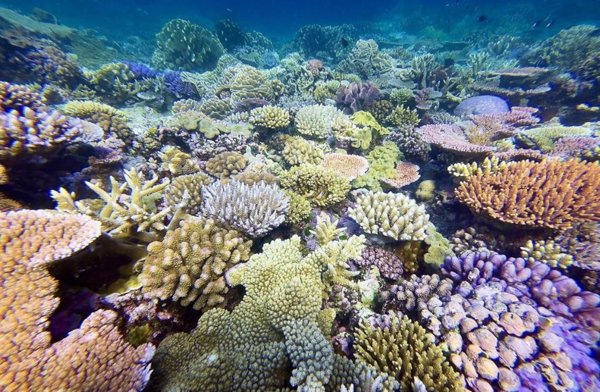
Corals, fundamental to marine biodiversity, face serious threats due to climate change. However, recent research indicates that these organisms could be developing greater resilience to environmental adversities.
A study published in the journal Science Advances by a researcher at the University of Colorado at Boulder reveals that, despite the progressive increase in ocean acidity in the last 200 years, certain corals seem to have the ability to adapt and continue forming their hard, stony skeletal structures.
Jessica Hankins, first author of the paper and a PhD student in the Department of Geological Sciences, commented: 'We found that corals have managed to regulate the mechanism they use to build and maintain their skeletons, despite increasing ocean acidity. It is an unexpected and hopeful sign; "However, we need more long-term data to understand its true meaning."
The process of formation of the coral skeleton
As corals grow, they form their skeletons by absorbing ions from seawater in a space between the existing skeleton and the soft tissue that covers it, called coral calcifying fluid. This fluid is regulated by the coral, which adjusts its chemical composition to create the right conditions for calcium and carbonate ions to combine and form calcium carbonate, the material that makes up their skeletons.
Impact of increasing ocean acidity
The ocean absorbs approximately 30% of carbon dioxide emissions generated by human activities. As more CO2 dissolves into the ocean, a chemical reaction occurs that acidifies the sea surface. Previous studies indicate that ocean acidity has increased by 40% since the Industrial Revolution and is expected to continue rising.
This phenomenon alters the balance of carbon species in seawater, resulting in a lower availability of carbonate ions, an essential element for corals to form their skeletons. Scientists had anticipated that ocean acidification would make it harder for coral skeletons to grow and maintain, which could lead to structures that were less dense and more vulnerable to breaking down. However, previous experiments, both in the laboratory and in the wild, have produced contradictory results.
Study of long-lived coral skeletons
In order to delve deeper into the topic, Hankins studied ancient coral skeletons, using advanced imaging technology known as Raman spectroscopy. This method, which uses lasers to reveal the chemical composition and molecular arrangement of various objects, provides detailed information about the chemistry of the coral skeleton.
When corals rapidly form the calcium carbonate mineral that makes up their skeletons, it usually happens when there is greater availability of carbonate ions. The resulting structures tend to contain other minerals that have been extracted from seawater. These impurities affect the molecular arrangement and structure of calcium carbonate, resulting in increased disorder in the coral skeleton under Raman spectroscopy analysis.
Hankins explained: "When conditions are favorable, corals seem to prioritize growth, even if that means producing skeletons that are a little more disordered at the molecular level."
Study results
The researcher analyzed two fragments of coral skeletons, one almost 200 years old and the other 115 years old, from the Great Barrier Reef and the Coral Sea, located off the northeast coast of Australia. Through Raman spectroscopy, he discovered that both corals were able to regulate the chemistry of their internal fluids to maintain the growth of their skeleton, despite the continued increase in ocean acidity. The corals managed to maintain calcium carbonate production even when the chemistry of the surrounding seawater became less favorable.
A mystery to solve
Despite these findings, it is still not fully understood how corals are adapting to this changing environment. Hankins suggests the secret could lie in the complexity of its calcifying fluid. "It is possible that the processes that corals use to modify and regulate their calcifying fluid are more complex than we have previously been able to deduce," he said. "Further studies are needed to determine whether different species, or the same species in different locations, have similar responses."
Additional challenges for corals
In addition to ocean acidification, corals face increasing stress due to rising sea surface temperatures, human-caused pollution, and unsustainable fishing practices. According to recent data, between 2023 and mid-May 2024, mass coral bleaching has been confirmed in at least 62 countries and territories around the world. This phenomenon occurs when corals expel the algae that live in their tissues, a process that is triggered under stressful conditions, such as high ocean temperatures, causing the corals to turn completely white.
The importance of coral reefs
Coral reefs are essential to one of the largest ecosystems on the planet. They provide protection to coastlines, which are vulnerable to erosion and storm damage. Additionally, these marine ecosystems provide habitat, breeding grounds, and spawning areas for a wide variety of marine organisms. The preservation of corals is essential not only for their biodiversity, but also for the ecological and economic benefits they provide to coastal communities.
Leave your comment
To comment you must be registered and logged in.
Comments (0)
There are no comments yet.