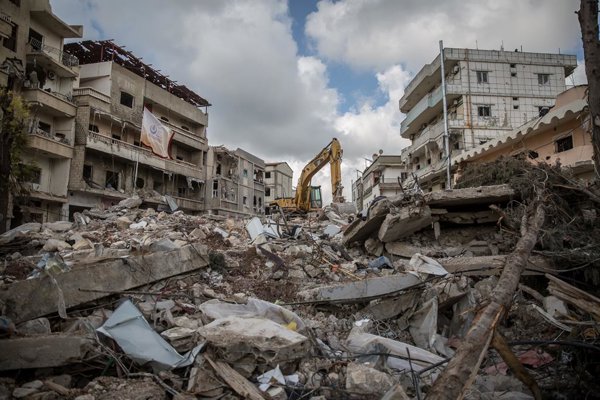
An unexpected ceasefire
In a day that promised to be more of the same on the international stage, the president of the United States, Donald Trump, surprised everyone by announcing the extension of the ceasefire between Israel and Lebanon for three weeks. The news came late on Thursday, just after a meeting between delegations from both countries was held in Washington. An event that, according to Trump himself, was “historic,” although the echo of those words resonates differently in every corner of the world.
The situation in the Middle East is a recurring topic in coffee conversations and on social media. Ordinary people, who sometimes feel that international politics is too big for them, wonder what this extension really means. Is it a momentary relief or just a band-aid on a wound that never stops bleeding? The reality is that, while Trump rejoices on his social networks, the conflict between Israel and Lebanon remains an open wound, with a background of tensions that cannot be resolved with a simple announcement.
Trump's diplomacy
"The meeting went very well!" Trump exclaimed on his Twitter account, as if it were a soccer game in which his team had just won. But what is behind that statement? The presence of the American president at this type of meeting is not coincidental. His administration has been seeking a more active role in the region, and this meeting, which included key figures such as Israeli Prime Minister Benjamin Netanyahu and Lebanese President Joseph Aoun, is part of a broader strategy.
The vice president, JD Vance, was also present and did not spare his praise for the president. “This is a momentous historical moment,” he said, as if history were being written at that very moment. However, the optimistic rhetoric collides with the harsh reality that citizens in both countries experience. Violence and suffering do not stop with big words, and many wonder if this truce is more than a simple game of political chess.
Trump's direct participation in the mediation has been highlighted as an achievement, but the question that remains is: is anything substantial really being achieved? The region's recent history is full of broken promises and agreements that never materialized. The hope that this time will be different faces a skepticism rooted in the collective memory of the people.
Reactions on the ground
While the leaders congratulate themselves in Washington, on the streets of Beirut and Tel Aviv, the situation is different. People continue to deal with the consequences of a conflict that has left deep scars. In Lebanon, Hezbollah's presence remains a hot topic, with many wondering whether the aid promised by the United States will actually reach those who need it most. The distrust of foreign intentions is palpable, and no wonder.
On the other hand, in Israel, the population also lives with the uncertainty of a ceasefire that could be ephemeral. Security is a constant concern, and although the truce sounds like heavenly music, the fear of a new outbreak of violence never completely goes away. Families continue to hope that peace is not just an abstract concept, but a tangible reality that allows them to live without fear.
Political analysts, from their comfortable offices, try to unravel the meaning of this new chapter in the relationship between both countries. Some see the extension of the ceasefire as an opportunity to move towards a deeper dialogue, while others are more pessimistic and consider it a mere maneuver to buy time. Ultimately, the question everyone is asking is: who really benefits from this situation?
An uncertain future
The meeting in the Oval Office, with all its protagonists, has been presented as a milestone in American diplomacy. However, the true impact of this meeting will be measured in the streets, where ordinary people live the consequences of decisions that are often made far from their reality. History has taught us that agreements can be fragile, and that peace, when it comes, is not always lasting.
The rhetoric of Trump and his administration may sound convincing, but the region's recent history reminds us that words do not always translate into effective actions. The extension of the ceasefire is a step, yes, but it is nothing more than a small advance on a path full of obstacles. The international community watches closely, but also with skepticism, as the citizens of Lebanon and Israel continue to wait for a solution that will allow them to live in peace.
In the midst of this panorama, the question that remains is whether this truce will be enough to change the course of a conflict that has lasted for decades. History continues its course, and more challenges are on the horizon. The reality is that, while leaders gather and celebrate, the lives of millions of people remain marked by uncertainty and fear.
“It has been a great honor to participate in this historic meeting,” Trump said, but deep down, many wonder if that honor will translate into more than just empty words.
Leave your comment
To comment you must be registered and logged in.
Comments (0)
There are no comments yet.