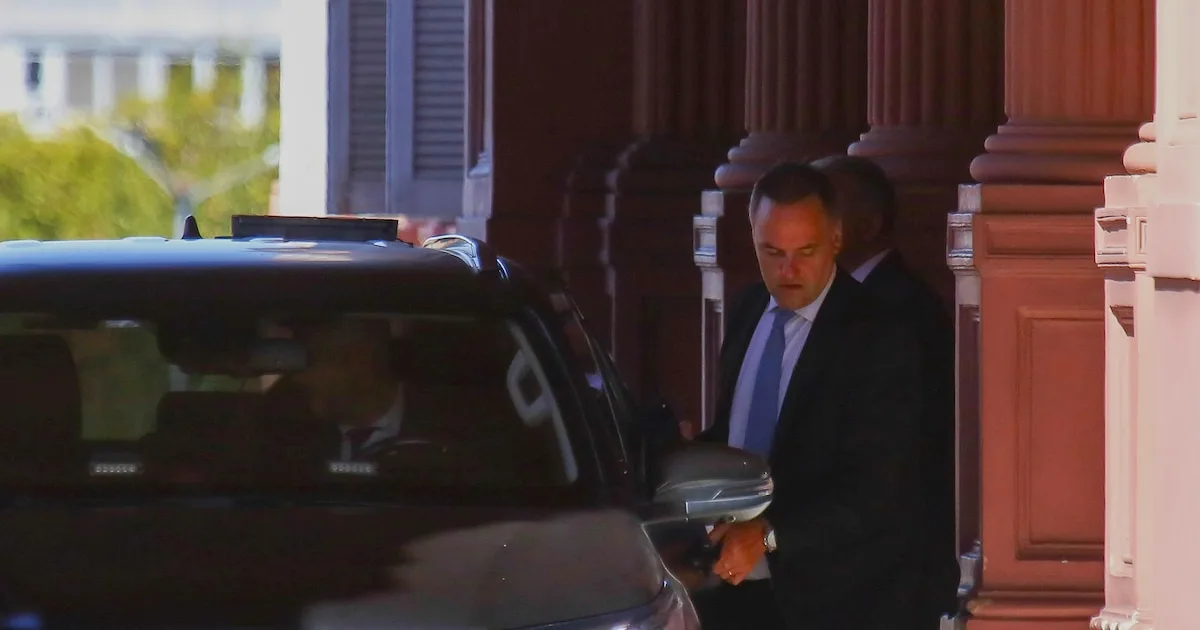

The president of Argentina, Javier Milei, has lifted the blockade that has kept the press outside the Casa Rosada since April 23, 2026. However, the return to this emblematic building has not been without conditions. From now on, journalists accredited by Casa Militar, the body in charge of presidential security, must comply with a strict entry protocol that limits their freedom of movement within the presidential palace.
Reinforced security measures at the entrance
The entry of journalists will be carried out exclusively through the Balcarce 78 address, where a rigorous security control has been implemented. Professionals must present their identity document and credential to be admitted. In addition, scanners and metal detection devices have been installed, complemented by the presence of several members of Casa Militar who monitor the section towards the press room located in the east wing of the Casa Rosada.

This new security scheme, designed by Major Colonel Sebastián Ibáñez, has eliminated the previous entry system that used a fingerprint registration at Balcarce 24. These measures seek to more strictly control internal circulation, which has generated controversy among press workers.
Restrictions on iconic spaces
Historically, journalists have had free access to the Patio de Palmeras, a common area within the Casa Rosada. However, under the new restrictions, access to this area has been completely prohibited. The measures also include the limitation of access to the first floor balcony and the Hall of Busts, where the windows were frosted and doors were closed to prevent visualization of the internal activity.
Official reactions and justifications
Manuel Adorni, Chief of Staff and currently under investigation for alleged illicit enrichment, has announced that he will resume the press conferences this Monday, where he is expected to address recent changes to access policies. From the Secretariat of Communication and Press, directed by Javier Lanari, it has been argued that these changes were foreseen in the press accreditation annex, although previously “transitional circulation” through some common areas was guaranteed.
Legal and political implications
The changes in the policy access do not only respond to security issues. The decision to restrict access came after the broadcast of a program on the TN channel on April 19 that included recordings of the internal corridors of the Pink House, considered by the ruling party as a threat to national security. Sebastian Ibanez filed a complaint brought to justice against those responsible for the broadcast, with the investigation falling to Federal Court No. 4.
In parallel, the Ministry of Communication and Media has indefinitely suspended the journalist involved in the recording, which has generated a debate about press freedom and the right to information.
Impact on the daily life of journalists
The new restrictions have changed drastically the work environment of the journalists in the Casa Rosada. They will only be able to travel through the corridors that lead to the Journalists' Room, located in the center of the Government Palace. Access to the dining room in the basement will be allowed only through the central stairs, and only the cafeteria and bathrooms will be enabled.
These measures have been justified as necessary to protect the safety of the building and the staff who work there, but they have been criticized by press organizations that denounce an attack on transparency and the practice of journalism.
Subscribe to Uruguay Al Día
Receive the most important news directly in your email. Clear, independent and updated information every day.
Follow us on WhatsApp
Join our official channel and receive alerts, news and exclusive content from Uruguay Al Día.
🔔 Join the WhatsApp channel