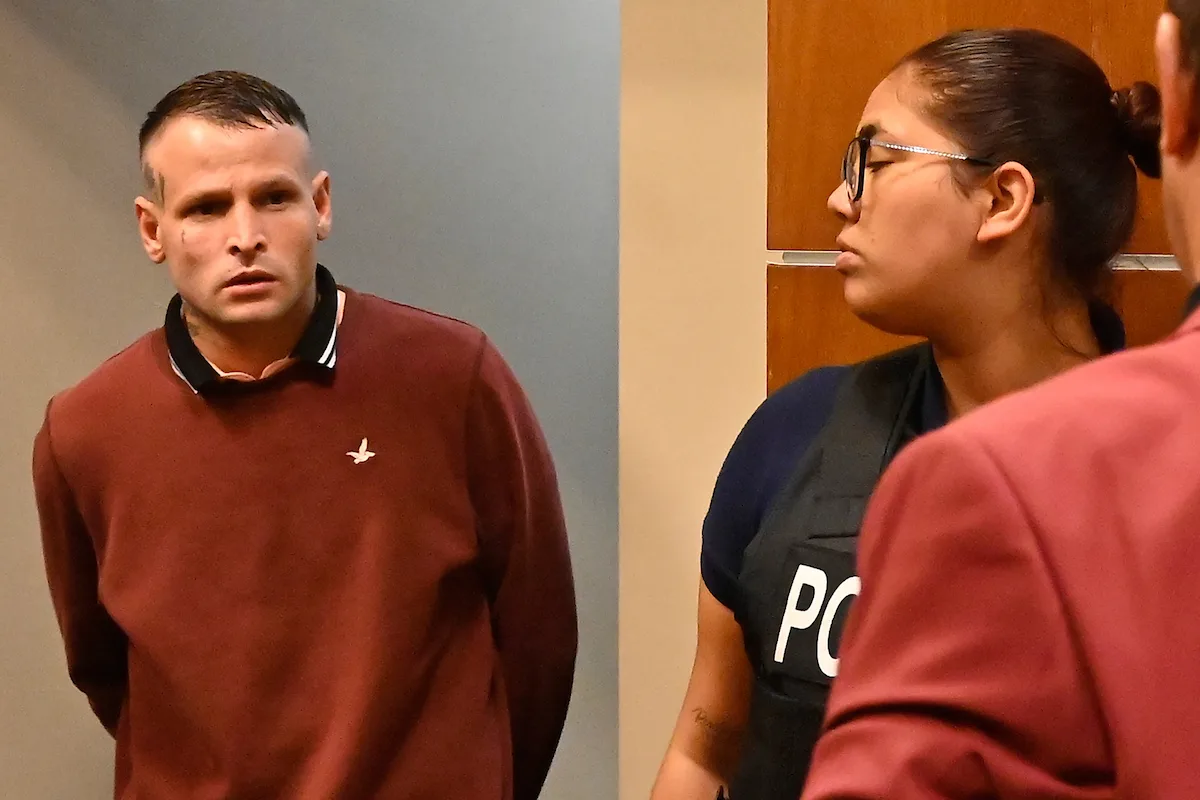

Judicial tolerance has a limit, and for Moisés Martínez, that limit arrived this Tuesday. After a series of departures that jeopardized his stay at home, the Court of Appeals decided to revoke the benefit of house arrest that had been granted to him months ago. The man, convicted of the murder of his own father in May 2025, must pack his bags to return to preventive detention until November 26.
The ruling, which this media accessed, is lapidary. This was not an isolated error, but rather a repeated behavior. In just eight days, Martínez accumulated three departures from his authorized perimeter. The explanations given by his defense—technical problems with the electronic anklet on two occasions and an alleged confusion due to psychotropic drug use on the third—were not enough for ministers Graciela Eustachio and Dolores Sánchez, who made up the majority.
A history of departures that did not convince
Martínez's scenes outside his home were documented and presented by the Homicide Prosecutor's Office, which from the first minute insisted that the arrest was not being carried out as it should. The most serious episode was a 29-minute outing. The defense tried to argue that Martínez was disoriented under the effect of medication, but the Court was categorical: the reason for “force majeure” was never proven.
To the judges, the justifications were implausible at best. The message that now comes from the Court is clear: house arrest is a privilege that requires absolute responsibility, and whoever does not understand it, loses the benefit. Meanwhile, on the opposite side, Minister Marcelo Malvar voted to maintain the measure, suggesting that it was enough to intensify control, although he was in the minority.
The case that shocked public opinion
Martínez's case is not one more in the Uruguayan police chronicle. Since the murder of his father in 2025, the file has been surrounded by constant media attention. Even the journalistic treatment of the case, which included television reports that the family of the deceased described as “disastrous,” ended in public exchanges between communicators and relatives.
Now, with this new resolution, the chapter on house arrest is closed. The climate of tension surrounding this case promises to continue until the next judicial instance. For the victim's family, Martínez's return to prison is a necessary response to what they considered a “soft” measure for a crime of such magnitude.
What's next?
Martínez must already be being notified about his transfer. The preventive detention will last at least until the end of November. The defense lawyers, Rodrigo Rey and María de la Paz Echetto, had bet everything on their client being able to continue with his psychological treatment in freedom, but the court prioritized the rigor of the precautionary measures over the defense arguments.
The Uruguayan Justice has put an end to the controversy over ankle bracelets and unauthorized exits. Martínez returns to the cell, and with this, the relative calm that he had found in his house ends. The question that remains in the air is whether this episode will mark a before and after in how the penal system evaluates the granting of domiciliaries for blood crimes.
Subscribe to Uruguay Al Día
Receive the most important news directly in your email. Clear, independent and updated information every day.
Follow us on WhatsApp
Join our official channel and receive alerts, news and exclusive content from Uruguay Al Día.
🔔 Join the WhatsApp channel