The echo of the war on the border
In a corner of the world where tension is felt in the air, the border between Israel and Lebanon has become a scene of exchanges of fire that resonate beyond its limits. The Israeli town of Shtula, a small settlement that seems oblivious to the maelstrom of international politics, has been the epicenter of a new chapter in the conflict between the Israeli Army and Hezbollah, the Lebanese Shiite militia party. While a diplomatic meeting between both countries was held in the United States, the reality on the ground was different: rockets and bombings followed one another in a macabre dance that gives no respite to the civilian population.
On Thursday night, at 11:15 p.m. local time, Hezbollah launched a "rocket salvo" against Shtula. The news came through a statement from Al Manar, a television channel linked to the group. The justification for the attack was not long in coming: Hezbollah considered it a response to what they call "the violation of the ceasefire" by Israel. In the background, the story of a conflict that seems to have no end, where each action provokes a reaction that fuels a cycle of violence.
The violence doesn't stop
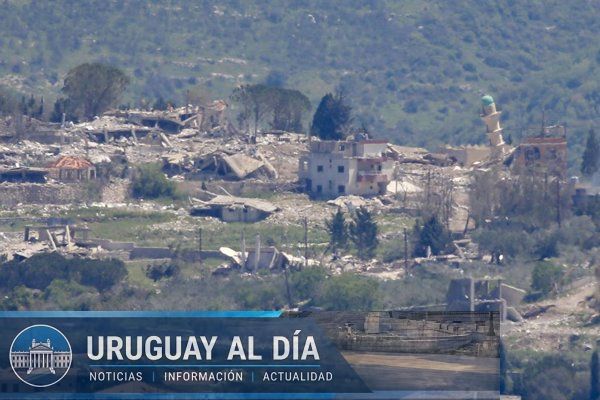
The hours following the attack witnessed an escalation that left traces on both sides of the border. In southern Lebanon, an Israeli bombing wounded at least two people, including a minor. The town of Yater, in the Nabatiye governorate, was the target of the Israeli offensive, which also extended to Shukin, where three people lost their lives. The civilian population, caught in the middle of this crossfire, lives in a state of constant uncertainty, with fear as a life companion.
From the Israeli side, the response did not take long to arrive. An Army spokesman said his forces had attacked the launcher from which the rockets were fired. The logic of war prevails: one attack leads to another, and thus a cycle that seems to have no end is perpetuated. War rhetoric takes over speeches, while people's lives become figures and statistics.
The situation is further complicated by the announcement of an extension of the ceasefire for three weeks, a fact that coincided with the statement by the President of the United States, Donald Trump, on his social networks. However, on the ground, the reality is different. The extension of the ceasefire seems more like an attempt to calm the waters than a real solution to the conflict. The question that remains floating in the air is whether this truce will be enough to stop the violence or if, on the contrary, it will only serve to accumulate more grudges and resentments.
The game of powers
In the midst of this chaos, the role of international powers cannot be ignored. The United States, with its influence in the region, is trying to mediate in a conflict that has left thousands dead and displaced over the years. However, recent history shows that external interventions often complicate more than solve. Diplomacy becomes a chess game where the pieces are human lives, and the results are uncertain.
The international community is watching closely, but the reality on the ground is that decisions made in distant offices do not always reflect the needs of those living on the border. The voice of ordinary people, of those who suffer the consequences of this war, is lost in the noise of negotiations and official announcements. Politics becomes a labyrinth where the interests of a few prevail over the well-being of many.
An uncertain future
Meanwhile, life in Shtula and nearby towns continues to be marked by uncertainty. The population faces an uncertain future, where each day can bring with it the threat of a new attack. The stories of those who live in this region are stories of resistance, of struggle for survival in a context where peace seems a distant dream.
The voices of the inhabitants, who cry out for a lasting solution, are drowned in the echo of gunshots and explosions. War has become a draining routine, where hope is eclipsed by fear. The question that remains is whether a path to peace can one day be built, or whether this cycle of violence will continue to be fueled by resentment and revenge.
In the midst of this panorama, the international community continues to debate the future of the region, while the lives of thousands of people continue to hang in the balance. The reality is that, on the border between Israel and Lebanon, the war is not just a conflict between armies, but a fight for life itself.
The ceasefire will be extended for three more weeks.
Leave your comment
To comment you must be registered and logged in.
Comments (0)
There are no comments yet.